
Software Factory fundamentals
Implement
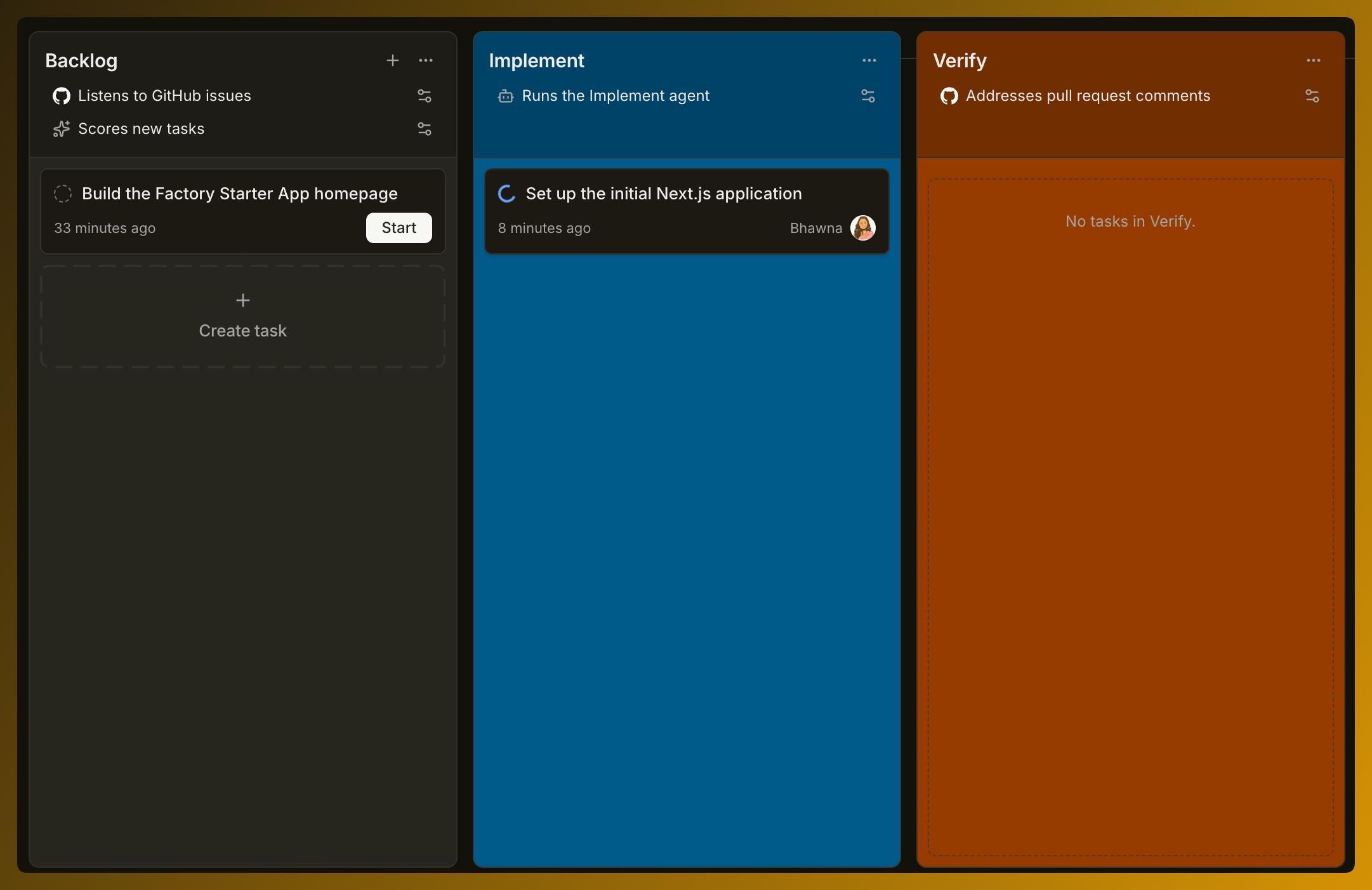
See how an approved task becomes a reviewable software change.Implement is where an approved task becomes a concrete change. The Factory owns the sequence and the guardrails. The coding agent works inside them: it inspects the repository, changes the code, runs the available checks and prepares the result for review.
The workflow and the agent have different jobs
Section titled “The workflow and the agent have different jobs”The workflow decides when implementation begins, what context enters the run and what must happen after it. The agent decides how to perform the assigned code change within that boundary.
This division keeps process rules outside the prompt. A repository connection, a pull request requirement or a failure route should be a visible part of the automation. The agent prompt can then focus on the work itself.
A typical implementation run
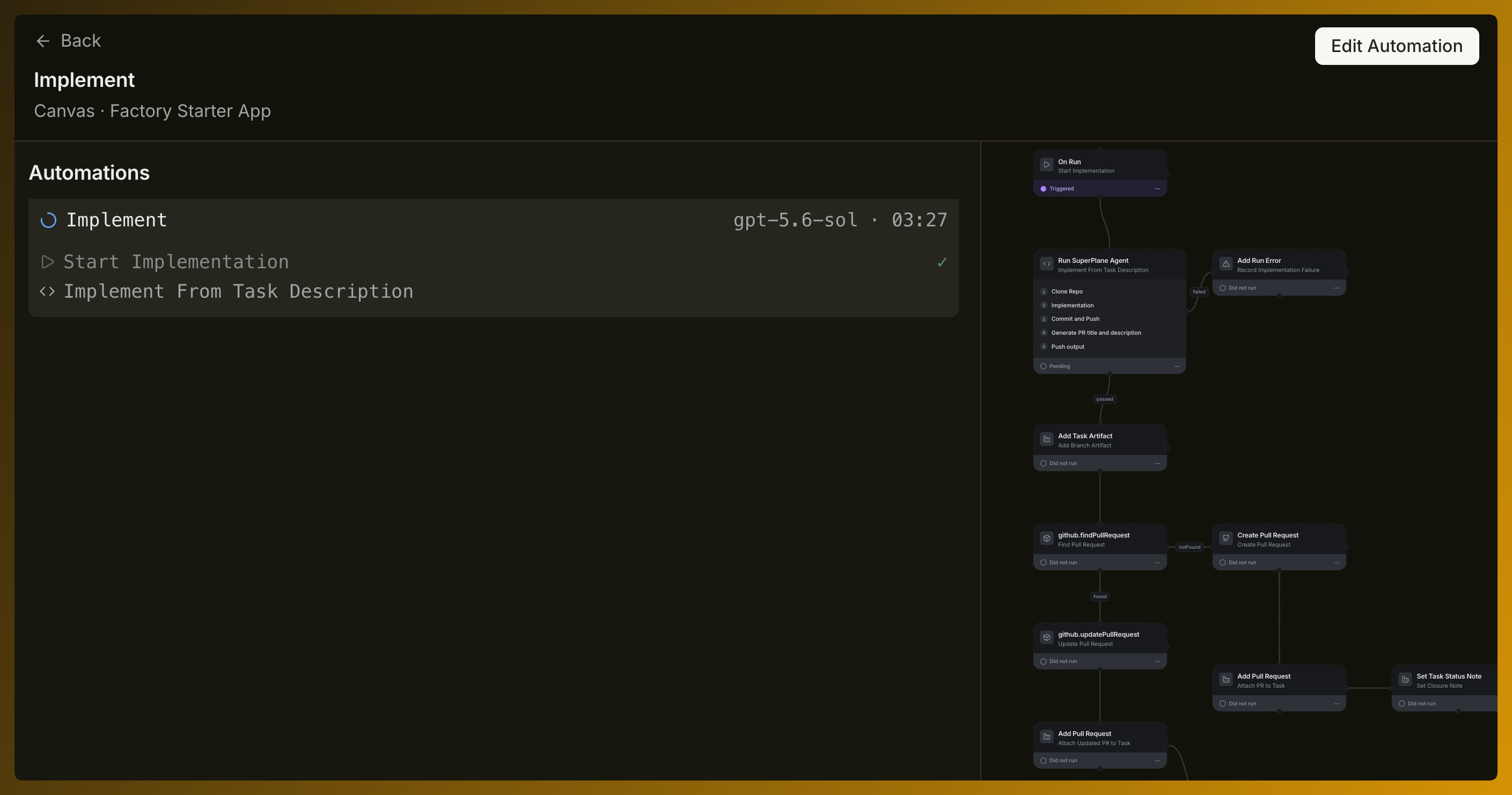
Section titled “A typical implementation run”The exact graph is configurable but most implementation runs follow the same practical shape.
Understand before editing
Section titled “Understand before editing”The agent starts with the task, source issue and repository instructions. It should find the relevant code path and identify the behavior that must stay unchanged. For a small task, this may be only a few files. For a broader task, the plan creates a useful checkpoint before code is touched.
Produce a reviewable change
Section titled “Produce a reviewable change”Implementation is not complete when files have changed locally. The result needs a durable form that the rest of the engineering system can inspect. That normally means a commit on a branch and a pull request that explains the change, its checks and any remaining uncertainty.
Keep the process observable
Section titled “Keep the process observable”Every component in the automation receives an input and emits an output. Those messages build a record of the run. You can inspect the path that executed, the step that failed and the artifact created for the task.
Durable execution changes how failures are handled
Section titled “Durable execution changes how failures are handled”A long-running implementation can cross API calls, agent sessions and external checks. SuperPlane records the state between those steps. If a service is temporarily unavailable, the run can resume from a known boundary instead of beginning the entire task again.
Durability does not mean retrying every failure blindly. A retry is appropriate for a transient system error. A failing test is useful information about the change and should be returned to the agent with its output. A product decision should pause for a person. Each case needs a different route.
What should leave Implement
Section titled “What should leave Implement”Before the task moves forward, the stage should have produced:
- a change tied to the original task
- a branch or pull request that the team can inspect
- a concise explanation of what changed
- the checks already run during implementation
- explicit notes about assumptions or unresolved questions
The next stage should not have to reconstruct the agent’s intent. It should receive the change and the evidence needed to evaluate it. Continue to Verify.